
As a dedicated home learning educator embarking on a thrilling second full-time year of teaching my 2nd and 4th grade girls, I find myself pondering a profound question: “What is the utmost essential knowledge that I must impart to my precious learners right from the very first day?” Is there a vital lesson that surpasses everything else in terms of its significance and impact, a lesson that they simply cannot afford to miss out on?
I pose this question deliberately, recognizing the constraints of time when it comes to imparting knowledge. Thus, it becomes essential to prioritize certain subjects and emphasize their significance over others.
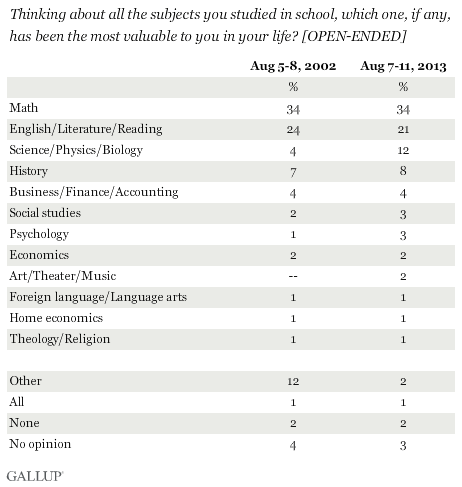
There is merit in referring to a Gallup poll conducted in 2013, as it provides valuable insights into the subjects deemed most worthy by the American populace. Although the pollsters did not explicitly define the term “value,” we can readily understand it to encompass topics of utmost importance, held in high regard, and considered truly worthwhile.
The poll results are shown below in figure one. It’s no surprise math, English, and science combine for 67% of respondents as most valuable, especially if the majority of people view value from a secular perspective (e.g., future income potential, career success). Jobs that require a high level of mathematical aptitude tend to pay better than jobs in theology and religion. But does that make them more valuable?
I also find it interesting the similarities between political affiliations and response to the question of value (see figure 2). Finally, something conservatives and liberals mostly agree on!

Should math be the top priority?
When it comes to education, the question of which subject should be taught first is often a matter of debate. Some argue that math should be the priority, as it lays the foundation for logical thinking and problem-solving skills. However, others believe that there is a fundamental knowledge that should be imparted to children from day one, regardless of the subject.
In my opinion, it is not the subject itself that holds the most value, but rather the mindset and approach to learning that children need to cultivate. Instead of focusing solely on math or any specific subject, we should prioritize teaching children how to learn, think critically, and search for knowledge.
By emphasizing the importance of curiosity, creativity, and adaptability, we can inspire children to explore the world around them and develop a genuine love for learning. This holistic approach to education can help children to become well-rounded individuals who are equipped to handle various subjects and challenges that they may encounter throughout their lives.
The goal is not to raise good children but to guide our children on the path to becoming great adults.
Therefore, while math is undoubtedly a vital component of education, we should not overlook the significance of other subjects such as English, reading, science, and history. Each subject contributes to a well-rounded education and fosters different skills that are valuable for personal and intellectual growth.
Furthermore, instead of emphasizing a specific subject as the first thing every child needs to learn, we should focus on providing children with a solid foundation of critical thinking, creativity, and especially a thirst for knowledge.
In other words, the first thing children need to learn is truth – what truth is and how to discern truth from non-truth. This approach will empower them to excel in any subject they choose to pursue, making their educational journey not only fruitful but also meaningful.
Defining Truth
What is truth? Here’s a simple definition of truth that is easy to understand regardless of age and / or educational level:
Truth is what is real.1
Something that is “real” actually exists as a thing or occurs as a fact, not as something that is imagined or supposed. To be real means to not be imaginary, fictitious, or theoretical.
How do we come to know truth?
Apologist, speaker, and author James Sire before his death in 2018 used to conduct a seminar titled, Why should anyone believe anything at all? He would start the seminar with the question, “Why do people believe what they believe?”
The responses would fall into one of four categories Sire would use to help participants better understand how people come to know truth. Table 1 summarizes the four source categories.
| Sociological Reasons | Psychological Reasons | Religious Reasons | Philosophical Reasons |
|---|---|---|---|
| Parents Friends Society Culture Social Media News Media | Comfort Peace of Mind Meaning Purpose Hope Identity | Scripture Pastor Priest Imam Rabbi Guru | Logic Evidence Science Reason Consistency Coherence |
Next, Sire would ask questions regarding the quality of the truth sources. For example, a student might say they know something is true because their parents told them it was true. To which he would respond, “Just because your parents said it’s true is that a good reason to believe it’s true?” Of course, they would say, “no” that’s not a good reason. Parents can be wrong sometimes.
Some would say a truth makes them feel good, or what Sire would describe as psychological reasons for truth. You may feel that God exists and cares about you, which makes you feel safe and secure, but that doesn’t necessarily mean it’s true. Feelings are different than truths.
Students may also cite the Bible or the Quran as a source of truth, what Sire described as religious reasons. However, they both can’t be true since they contradict one another in many ways. One such way is Jesus’ crucifixion. The Bible says Jesus was crucified (1 Corinthians 15:1-8), but the Quran says he was not crucified (Sura 4:157). They both can’t be right.
What could we do to determine which of these accounts of Jesus’ crucifixion might be true? We could look at proofs outside these writings and / or the validity of the Bible and the Quran to evaluate the evidence and data for and against Jesus’ death. This, concluded Sire, is the fourth category, philosophical reasons, which is the best way to determine truth.
Buy truth, and do not sell it; buy wisdom, instruction, and understanding.
Proverbs 23:23
When you remove opinions and feelings, and focus on facts, you’re more likely to get to an unbiased version of the truth. As Ben Shapiro writes, “Facts don’t care about your feelings.”
I would argue social, psychological, and religious sources of truth are potential starting points in uncovering and discussing reality, but ultimately one needs to back it up with reason, logic, and evidence to validate or reject opinions and feelings.
Does absolute truth matter in 2023?
According to a study conducted by Barna Research, 74% of young people in America hold the belief that absolute truth does not exist. Furthermore, this perspective is shared by 58% of all adults. Consequently, the notion of truth has become increasingly subjective, with individuals determining their own personal truths.
Regrettably, the erosion of the belief in absolute truth is viewed as one of the leading factors contributing to the moral decline in contemporary American society. This shift has prompted a reevaluation of fundamental concepts such as life, marriage, sexuality, and gender, leading to revisions in societal perceptions.
This is the core of what every child needs to be taught on day one regarding truth – truth comes from the heart and mind of God. He is the Creator of all things, including truth.
If absolute truth does not exist what is the point of education of any kind? If I can have my truth and you can have your truth what value does formal education have? None.
Tactics for Teaching Truth
Apologist Greg Koukl has what I consider one of the simplest and most effective apologetic tactics – what he calls the “Columbo tactic“. If you are not familiar with Columbo, he was a detective on a TV show from years ago and his approach was to ask lots of questions to get to the truth.
We can use this tactic with our children by teaching them to ask two simple questions when seeking the truth.
Q1: What do you mean by that?
This first question both helps and challenges. It helps the one asking the question to get a fuller understanding of what a person is claiming to be true.
For example, someone might say, “I don’t believe in God.” Asking, “What do you mean by that?” then challenges the person making the claim to expand on what they said. At the start of the exploration the goal should be to seek to understand before you strive to be understood later, and this first question helps to do that.
Therefore, you might respond with, “Are you referring to the God of the Bible, the gods of Hinduism, the god of the Quran?” What one person means by “God” may not be the same as what another understands as “God”, so asking this first question ensures a common understanding before moving on to question two:
Q2: Why do you believe this is true?
The second question is where most people making what they believe are statements of “fact” often display a weakness by not being able to defend what they believe with anything beyond feelings or opinion.
Keep in mind, the goal is not to make others look foolish, but to truly understand what they believe and why they believe it to be true.
To finish out the tactic, Koukl suggests you open the door to sharing or seeking out the truth together by saying, “Have you ever considered…” followed by sharing what you believe is the truth.
For example, you could respond to someone who says the Bible can’t be trusted because the autographs (original writings) have been lost with a statement such as, “Have you ever considered there are over 5,000 Greek New Testament manuscripts that if you stacked them up would be over a mile high. In comparison if you stacked up writings by the average classical writer they would only be around four feet high.”
This example helps illustrate the point that most people accept classical writings such as Plato’s work, which we only have 250 copies of, to be a valid reflection of his original work, so why would anyone try to challenge the New Testament manuscripts, which we have over 5,000 copies in Greek alone?
Teach Them to Ask “Truth” Validating Questions
In conclusion, the single most important thing we can teach our children is truth is what is real, and by asking simple questions such as “What do you mean by that?” and “Why do you believe this is true?” we set them on a path to discover truths to base their lives upon.
When I was working on a doctoral degree a decade ago my professors would call such a person someone who has become a “critical consumer” of information. In the 21st century this has and will continue to be one of the most important things we can teach our children – to be critical consumers of information.
I’ll leave you with what Jesus spoke about the truth. This is a great place to start as you teach your children about truth.
First, Jesus is the truth.
I am the way, and the truth, and the life. No one comes to the Father except through me.
John 14:6
Second, Jesus came to be a witness to the truth. His voice (i.e., words) are truth.
For this purpose I was born, and for this purpose I have come into the world. To bear witness to the truth. Everyone who is of the truth listens to my voice.
John 18:37
Finally, If one is a true disciple of Christ (the ultimate goal for our children) they will abide (e.g., live by, obey, follow) in his words that will lead to freedom from sin and eternal life.
If you abide in my word, you are truly my disciples, and you will know the truth, and the truth will set you free.
John 8:31-32
Notes:
- This definition comes from Foundation Worldview.com’s Biblical Worldview Curriculum.
 The Great Forgetting